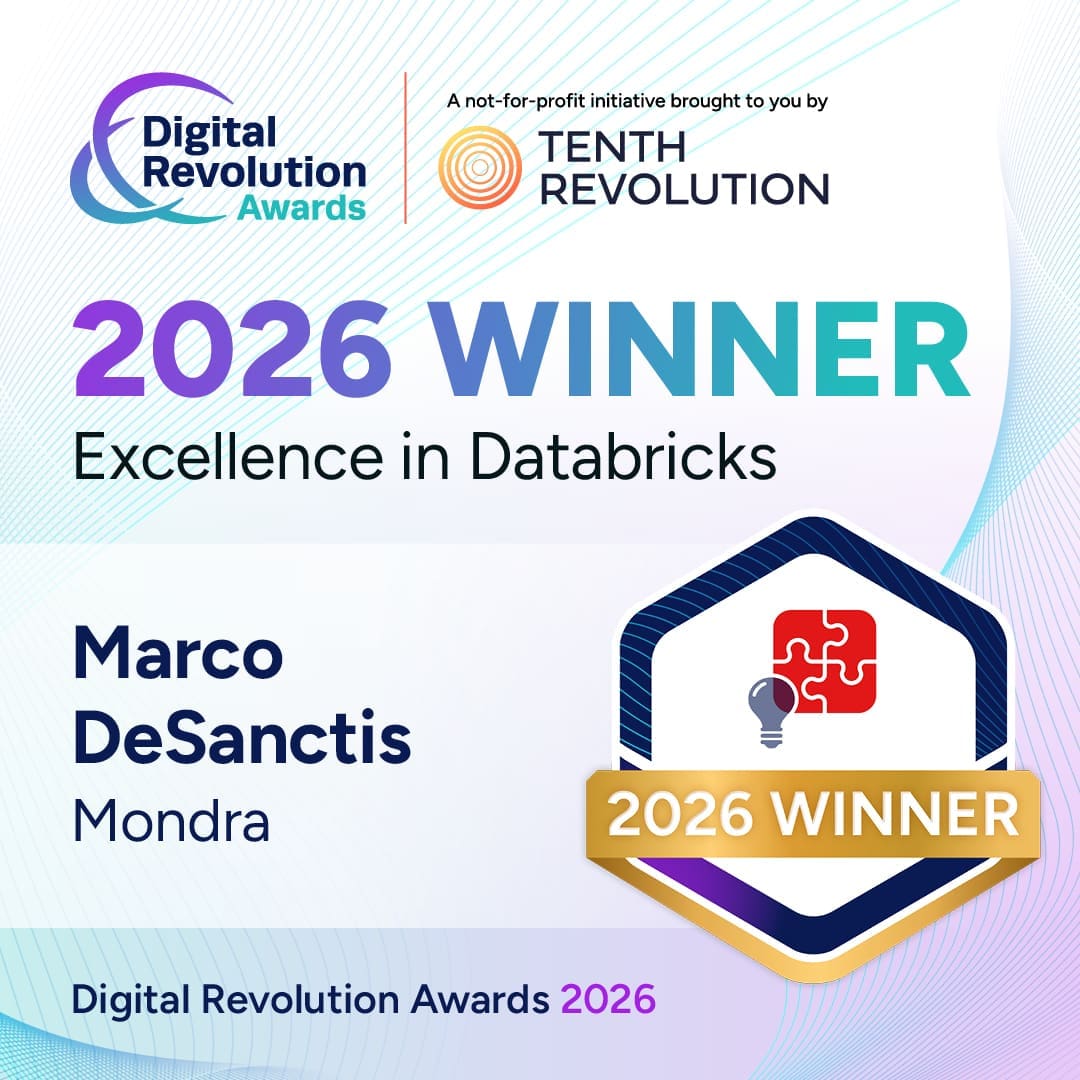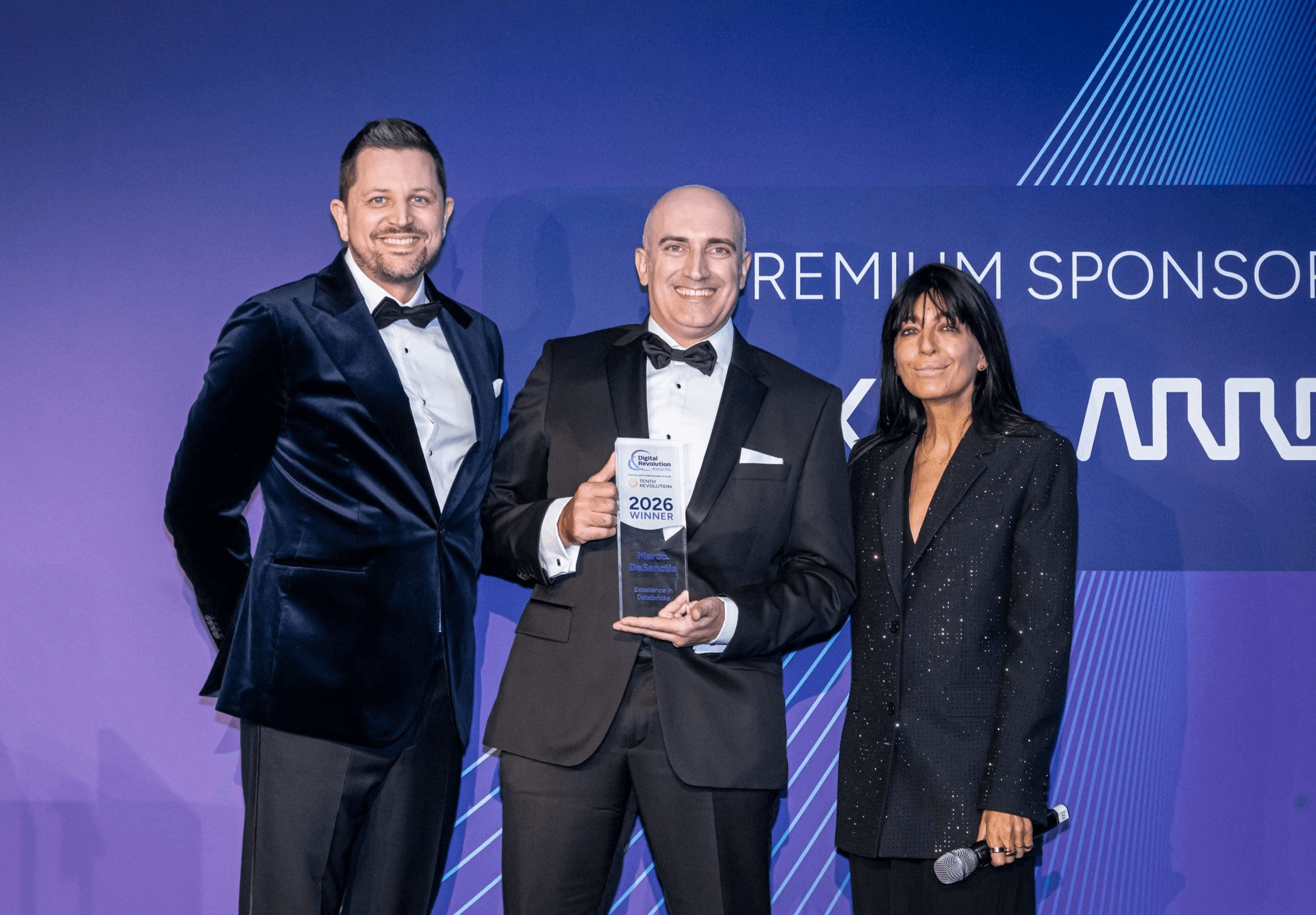
Last week, Mondra was named winner of the Excellence in Databricks Award at the Digital Revolution Awards in London.
Our CTO, Marco DeSanctis, accepted the award on the night, at a ceremony hosted by Claudia Winkleman. Mondra was shortlisted alongside organisations including Sega, Advancing Analytics, Unify, and Future Anthem.
For Marco, the award was all about the team behind it.
“It’s mostly an award for the rest of the team… they really deserve it. We managed to build something incredibly unique, which in some cases has astonished Databricks themselves.”
What the award recognises
The Excellence in Databricks category focuses on organisations pushing the boundaries of what’s possible with large-scale data processing and AI.
In practical terms, that means taking complex, fragmented, real-world data and turning it into something structured, usable, and decision-ready.
This is the problem Mondra has been built to solve.
Turning unstructured data into supply chain intelligence
As Marco described, Mondra starts with data that is rarely clean or standardised.
“Mondra receives data in an unshaped format from our clients… we try to make order out of this disorder.”
This includes recipe data, compliance data, ingredient lists, and supplier information. Often incomplete. Often inconsistent. Sometimes just plain text.
From there, Mondra transforms that data into product-level digital twins of supply chains.
• millions of interconnected nodes
• hundreds of thousands of products
• continuously updated as new data flows in
All processed on Databricks, using large-scale data pipelines and AI models to interpret, categorise, and structure what would otherwise remain unusable.
From weeks to hours
One of the less visible challenges in this space is time.
Traditionally, building this level of supply chain understanding has been manual. Slow. Resource-intensive.
Marco put it simply:
“This is the platform that allows us to do it in hours rather than days or weeks… how long it would take you to do it manually.”
This matters. Not just for efficiency, but for relevance.
Because decisions in food supply chains don’t wait for quarterly reports or static models. They happen continuously, under pressure, often with incomplete information.
Making complex systems usable
There’s a tendency in data and AI to focus on scale alone. But scale without usability doesn’t go very far.
At Mondra, the focus is on making this intelligence accessible to the people who actually need it:
• commercial teams
• product teams
• buyers
Not data scientists.
Which means translating complexity into something that can support everyday decisions. Not just surface insights.
A platform for what comes next
The work doesn’t stop at structuring data.
As Marco shared on the night, Mondra is already pushing further into agentic AI and more advanced forms of decision support. Conversations with Databricks at the event reflected that direction, with follow-up discussions already underway.
“They’re super interested in the direction of travel… the new things we’re doing with agentic AI in the platform.”
This is where the category is moving. From data platforms to decision systems.
A moment worth recognising
Awards like this are useful markers.
They show where the industry is starting to converge:
• from reporting to real-time intelligence
• from static datasets to dynamic systems
• from insight to action
For Mondra, it’s a reflection of the work already underway. And the direction it continues to move in.
Thank you
A thank you to the Digital Revolution Awards team, the judges, and everyone involved in recognising this work.
And to Marco, for representing Mondra on the night (and managing to shake hands with Claudia Winkleman in the process).
More to come soon, including the full video interview.